Week 4: When the Training Plan Meets Real Life
Four weeks into our 12-week cycling challenge, we started to learn something important: following a training plan doesn’t always mean following it perfectly.
This week, the fatigue started to catch up with us a little.
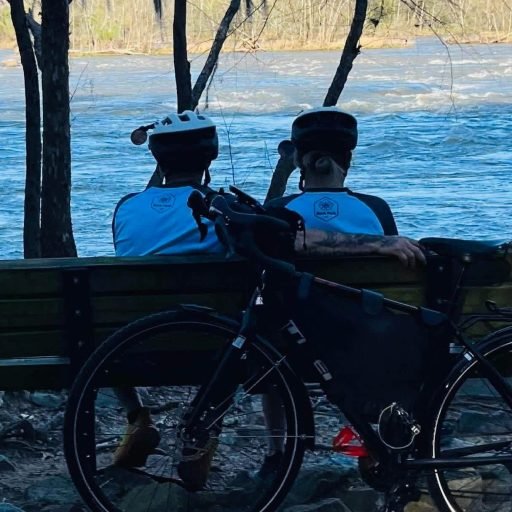
After several weeks of getting up early for rides, we just weren’t feeling it. The alarms might have gone off, but our motivation definitely didn’t. Instead of dragging ourselves out of bed, we moved two of our rides to the afternoon and headed back to one of our favorite places to ride—the river trail.
And apparently, being tired also makes us a little cranky.
Nothing dramatic happened. We were just feeling the accumulated effects of training, work, early mornings, and regular life. It was a good reminder that even when a training plan looks perfectly manageable on paper, your body doesn’t live on paper.
Changing the Schedule Instead of Skipping the Ride
One of the biggest lessons from this week was that changing a workout doesn’t automatically mean you failed at the workout.
Our original schedule may have called for a morning ride, but afternoon riding worked better for us this week. So that’s what we did.
Both of our shorter rides were at the river trail, which gave us a familiar, enjoyable place to get the miles in without making the week more complicated than it needed to be.
As we get farther into this challenge, we’re realizing that flexibility may be one of the most important parts of sticking with a training plan long enough to actually see results.
Sometimes you move a workout.
Sometimes you shorten one.
Sometimes you miss one completely.
And sometimes life may require you to take an entire week off.
The important thing is not turning one missed workout—or even several missed workouts—into a reason to quit.
What If You Miss a Workout?
This is something we wanted to talk about because real life is going to happen during a 12-week plan.
You might have a busy week at work. You could be traveling. The weather may be terrible. You might be exhausted, have family commitments, or simply need an extra recovery day.
If you miss one workout, you generally don’t need to cram it into another day just to check a box.
Instead, look at the rest of the week and decide what makes the most sense. If you can move the ride without stacking several harder days together, great. If not, skip it and continue with the plan.
One missed ride isn’t going to erase the work you’ve already done.
What If You Miss a Whole Week?
Missing an entire week can feel like a much bigger deal, but it still doesn’t mean your training plan is ruined.
Rather than immediately trying to make up every missed workout, consider where you are in the plan and how you’re feeling when you return.
You may be able to pick up where you left off. Or it might make more sense to repeat the previous week before progressing. If you’ve been away longer or feel like you’ve lost some fitness, backing up a little farther may make more sense.
The goal isn’t to finish the plan on an exact calendar date.
The goal is to build enough fitness to comfortably complete the ride you’re training for.
There is nothing magical about Week 12 happening exactly 12 calendar weeks after Week 1.
Taking the Mountain Bikes Off Road
Our long ride this week gave us another opportunity to make the plan work for us—and made Week 4 a lot more fun.
We traded the road bikes for our mountain bikes and headed to a gravel rail trail.
Of course, that changes things.
Mileage on a mountain bike over gravel doesn’t necessarily compare directly with the same mileage on a road bike over pavement. The bikes are different, the tires have more rolling resistance, and the riding surface can require more effort.
So rather than looking only at the number of miles, we used a cycling conversion chart to adjust our mileage and keep the ride in line with the purpose of that week’s long workout.
It also gave us a chance to get off road and do something different.
And honestly, that variety is part of what keeps cycling fun.
We’re training to become stronger cyclists, but we’re also training because we want to have more adventures on two wheels. Those adventures aren’t always going to happen on smooth pavement.
The Plan Is a Guide, Not a Test
Week 4 may have taught us one of the most useful lessons of this challenge so far.
A training plan gives you structure. It gradually increases the workload and gives you something to work toward.
But it shouldn’t become another source of stress.
There is a difference between consistently finding excuses not to train and making reasonable adjustments when your body or your life needs them.
We’re learning to tell the difference.
This week, we slept later.
We rode in the afternoon.
We were a little tired.
We were probably a little more irritable than usual.
We swapped pavement for gravel and road bikes for mountain bikes.
And we still trained.
That feels like progress.
Because if we’re going to make cycling a permanent part of our lives—not just something we do for 12 weeks—we need to learn how to make riding fit into real life.
Not the other way around.
Four weeks down. Eight to go.
Adventure is worth training for—even when the training plan needs a few adjustments along the way.
Watch episode 4 of our 12 Week Cycling Training Plan: https://youtu.be/vhzHOpK5-20?is=MMwEAuTNlkuXuvde